
English Typing Practice Paragraphs for Beginners – Improve Speed and Accuracy
Learning to type in English is easier when you practise with actual sentences instead of random letters. At first, you may need to look at the keyboard to find certain keys. You might also pause while typing longer words or forget to use capital letters and punctuation correctly. These are common problems when learning touch typing.
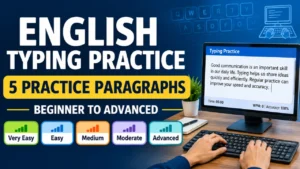
One useful way to improve is to practise English typing paragraphs at different difficulty levels. Paragraphs help you get used to complete sentences, familiar words, punctuation and longer text. They also give you a better idea of how comfortably you can type without stopping after every few words.
If you are preparing for SSC CGL, SSC CHSL, SSC MTS, Railway, Banking or another competitive examination, these exercises can help you develop basic keyboard skills. This article includes five English typing practice paragraphs, starting with simple sentences and moving towards more challenging text. Choose a level that matches your current ability and work through the passages at your own pace.
Why Practise English Typing with Paragraphs?
Typing individual words is a good way to learn where the keys are, but complete paragraphs offer a different kind of practice. You have to read ahead, type each sentence and remember where to use spaces, capital letters and punctuation.
For example, typing the word “education” repeatedly may help you remember its spelling. However, typing a complete sentence containing that word also helps you practise spacing, sentence structure and punctuation.
Paragraph practice is useful for several reasons:
- Better keyboard control: You become more familiar with the position of letters and punctuation keys.
- Fewer typing mistakes: You get opportunities to practise difficult words and correct repeated errors.
- Improved reading and typing flow: You learn to move from one sentence to another without unnecessary pauses.
- Practice with punctuation: You become more comfortable using capital letters, commas and full stops.
- Progress tracking: Repeating passages at different levels helps you compare your typing performance.
English Typing Practice Paragraphs for Beginners
Here are five English typing paragraphs arranged from very easy to advanced level. Each passage covers a different topic and includes vocabulary suitable for its difficulty level.
Before you start: Read the passage once, then type it without rushing. The word count is approximate and may vary slightly depending on how words are counted. Beginners can use a timer, but there is no need to compete against the clock during their first few sessions.
Paragraph 1 – Very Easy Level
Topic: My Daily Routine
I wake up early and get ready for the day. After breakfast, I check my books and make a list of the work I need to finish. I study for some time, take a short break, and then return to my lessons. In the afternoon, I help at home or read a story. Later, I revise what I learned in the morning. Before going to bed, I prepare my bag and decide what to study the next day. A simple routine helps me use my time well.
Approximate word count: 87 words
Practice advice: Start here if you are new to typing. Concentrate on spaces between words, full stops and basic spelling. Try typing the complete passage without looking down at the keyboard too often.
Paragraph 2 – Easy Level
Topic: Importance of Reading Books
Reading is a useful habit for people of every age. Books introduce us to new ideas, places and experiences. They can also help us learn unfamiliar words and understand how sentences are formed. A beginner does not need to start with a difficult book. A short story, a newspaper article or a page about a favourite subject is enough. The important thing is to read carefully and think about the meaning. Even a few pages a day can make reading feel more natural over time.
Approximate word count: 85 words
Practice advice: Pay attention to longer words such as “experiences”, “unfamiliar” and “important”. Try to type them correctly without breaking your rhythm.
Paragraph 3 – Medium Level
Topic: Technology in Education
Technology has changed the way students learn. Along with printed books and classroom lessons, they can now use online classes, digital libraries and practice tests. These resources make it easier to study at home and revisit a topic when needed. Still, students should choose reliable material and use their screen time wisely. Notifications and unrelated videos can interrupt a study session. A simple plan can help learners balance online study, revision and rest. Technology is most useful when students use it with a clear purpose.
Approximate word count: 85 words
Practice advice: This passage includes longer sentences and words with different letter combinations. Watch your spacing and avoid skipping small words while typing.
Paragraph 4 – Upper Intermediate Level
Topic: Time Management for Competitive Examinations
Preparing for a competitive examination takes planning. Before making a timetable, a student should understand the syllabus and check how much time is available. It is easy to spend too long on familiar subjects and postpone topics that seem difficult. A balanced plan should include new lessons, revision and mock tests. After each test, candidates should review incorrect answers and note why they made those mistakes. This gives them a clearer idea of what to practise next. Short breaks also matter; they help students return to their work with better attention.
Approximate word count: 91 words
Practice advice: Focus on commas and the semicolon in this passage. Check that you have typed short connecting words such as “and”, “before” and “after”.
Paragraph 5 – Advanced Level
Topic: The Role of Discipline in Achieving Goals
Discipline is not about following a perfect timetable every day. It is about returning to an important task, even when the day does not go as planned. Candidates preparing for competitive examinations may have to manage a large syllabus, household responsibilities and limited study time. They can make the workload easier to handle by setting realistic daily targets and reviewing their progress at the end of the day. The same approach works for typing practice. Instead of chasing a high score in every session, a learner can focus on a particular weakness, such as missed capital letters, extra spaces or difficult word combinations. Over time, this kind of focused practice makes it easier to type unfamiliar passages with control.
Approximate word count: 119 words
Practice advice: Take your time with longer words such as “responsibilities”, “particularly” and “combinations”. Pay attention to commas and sentence endings. Accuracy matters more than finishing the passage quickly.
How to Choose the Right Typing Paragraph
Not every beginner starts at the same level. Some people are already familiar with a computer keyboard, while others are learning to type complete sentences for the first time.
Use the following guide to select a suitable passage:
- Very Easy: Choose Paragraph 1 if you still need to search for keys or frequently make basic spelling mistakes.
- Easy: Choose Paragraph 2 if you can type simple sentences but need more practice with longer words.
- Medium: Choose Paragraph 3 if you are comfortable with basic paragraphs and want to improve your typing flow.
- Upper Intermediate: Choose Paragraph 4 if you can type continuously and want to practise longer sentences and punctuation.
- Advanced: Choose Paragraph 5 if you are comfortable typing unfamiliar text and want a more challenging exercise.
You do not have to move to the next level after completing a passage once. Repeat it if you are still making frequent mistakes.
How to Practise These English Typing Paragraphs
Follow these steps to get more value from each practice session.
1. Read the Passage First
Take a few seconds to read the complete paragraph. Notice unfamiliar words, punctuation marks and longer sentences. This makes it easier to follow the text while typing.
2. Type at a Comfortable Speed
Do not try to type faster than you can manage. Use the correct fingers and concentrate on entering each word properly. If you make a mistake, correct it according to the rules of your practice test.
3. Check Your Typing Result
After finishing, check the typing speed and accuracy if your practice tool provides these details. Note the words or keys where you made mistakes. Do not judge your performance by speed alone.
4. Practise the Difficult Parts Again
If a particular sentence causes trouble, type that sentence separately two or three times. This is more useful than repeatedly typing the entire passage without understanding where you went wrong.
Daily 15-Minute English Typing Practice Routine
If you have limited time, the following routine is a practical starting point. It combines basic exercises, paragraph typing and a short review session.
| Practice Activity | Time |
|---|---|
| Warm-up with simple words | 2 minutes |
| Type an easy or medium paragraph | 5 minutes |
| Practise difficult words and sentences | 3 minutes |
| Attempt a timed typing exercise | 3 minutes |
| Review mistakes | 2 minutes |
| Total | 15 minutes |
Beginners can start with this schedule and adjust the time according to their comfort. If you are struggling with accuracy, spend more time reviewing mistakes instead of adding another timed test.
How to Measure Typing Speed and Accuracy
Two common measurements used in typing practice are WPM and accuracy.
Typing Speed (WPM)
WPM stands for Words Per Minute. It indicates how quickly you type. Many standard typing tests treat five characters, including spaces, as one word.
Gross WPM = Total Characters Typed ÷ 5 ÷ Time in Minutes
For example, if you type 500 characters in five minutes, your gross typing speed is 20 WPM.
Typing Accuracy
Accuracy indicates how much of the given text you have typed correctly. Some platforms calculate it using correct characters, while others use words or a different method. Check the calculation method used by your typing tool before comparing results.
For beginners, it is useful to record both speed and accuracy after each session. This helps you see whether an increase in speed is also affecting the number of mistakes.
7 Common Typing Mistakes to Avoid
When practising English paragraphs, pay attention to these common problems:
- Looking at the keyboard repeatedly: It interrupts your reading and typing flow.
- Using only two fingers: Learning proper finger placement can make keyboard use more comfortable.
- Missing spaces: Check that separate words are not accidentally joined together.
- Forgetting capital letters: Practise using the Shift key at the beginning of sentences and for proper nouns.
- Ignoring punctuation: Commas, full stops and apostrophes are part of the passage too.
- Rushing through difficult words: Slow down when you reach unfamiliar or longer words.
- Skipping the review: Checking mistakes helps you decide what to practise in the next session.
Practise English Typing Online
Once you are comfortable with these paragraphs, try a timed typing exercise to check how you perform when there is a time limit.
You can visit our Free English Typing Test Online page to explore the available English typing practice option. Read the instructions on the page before starting and check the result provided by the test, where available.
You can use the paragraphs in this article for regular practice and the online test to assess your performance. This gives you a simple way to practise with different passages and review your progress.
Frequently Asked Questions (FAQs)
1. Which English typing paragraph is best for beginners?
Paragraph 1 is a suitable starting point for someone who is new to typing. It uses familiar words and simple sentences. Once you can type it comfortably, move to the next level.
2. How many paragraphs should I practise daily?
One or two paragraphs are enough for a short daily session. Focus on typing them correctly and reviewing your mistakes rather than trying to complete as many passages as possible.
3. How can I improve my English typing speed?
Learn the correct finger positions, practise complete sentences and work on the words you frequently type incorrectly. Use timed tests occasionally to check your progress.
4. Is paragraph typing useful for SSC examinations?
Paragraph practice can help candidates become more familiar with English typing and continuous text entry. However, the typing or skill test requirements differ between examinations and posts. Always refer to the latest official notification for the applicable rules and qualifying standards.
5. How long should a beginner practise typing every day?
A beginner can start with 10 to 15 minutes a day. Use part of the session for paragraph practice and the remaining time to review mistakes. Increase the duration only when you feel comfortable.
6. Should I type the same paragraph more than once?
Yes, repeating a paragraph can help you identify whether you are making fewer mistakes. However, also practise new passages so that you become comfortable typing unfamiliar words and sentences.
Final Words
English typing becomes easier when you practise with passages that match your current ability. Start with the simple paragraphs, pay attention to the mistakes you make and move to more difficult text when you are ready.
Use these five passages as part of your daily practice. If you are preparing for an SSC or another competitive examination, you can also include timed typing exercises in your routine to become familiar with working under a time limit.
Choose a paragraph, start typing and keep track of your progress. A short, focused practice session is a good way to build your typing skills.